Killer whale
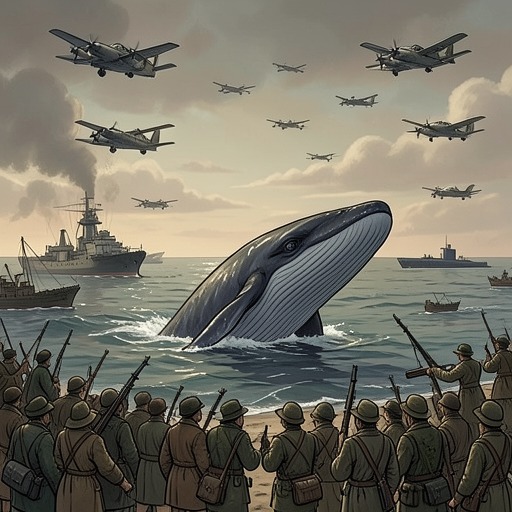
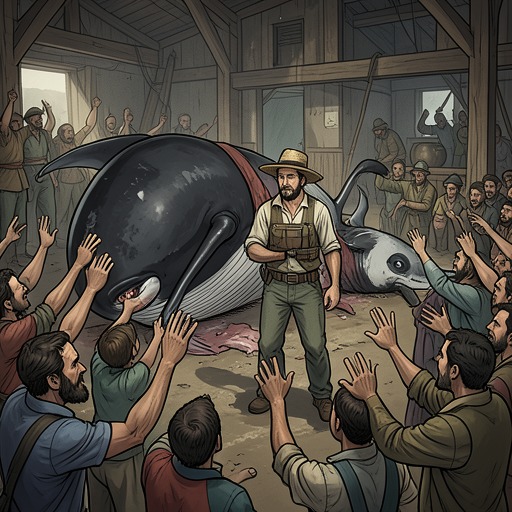
The WhaleThe killer whale occupies two sharply different roles in the book: a predator whose presence shapes other whales’ defenses, and a captive attraction whose trained performances are sold as entertainment. Its most sustained individual portrait is Ramu, captured from the ocean and exhibited at Windsor Safari Park. Through his story, the book sets the animal’s physical power against the limits imposed by a pool, and the cheerful assurances of captivity against the life that followed for the whale.
Classification and place in the ocean
The killer whale belongs to the toothed whales, or odontocetes. This group also includes porpoises, river and ocean dolphins, beaked whales, and sperm whales; in the book’s account it comprises seventy-one species, which feed on fish and squid. The contrasting suborder, the baleen whales, filters plankton and smaller fish through baleen. This classification places the killer whale among active hunters, but does not make its own social life or behavior interchangeable with that of other toothed whales.
The book describes killer whales as a natural danger to sperm whales. Sperm whales may prefer warmer waters partly because fewer killer whales are found at those latitudes. The qualification matters: the explanation is presented as a possibility, not a settled account of the whales’ distribution. More broadly, the open ocean offers no simple place to hide from an attack. A predator can approach through the water in three dimensions, so even heavily armed sperm whales may be vulnerable.
Predation and collective defense
The book gives the sperm whales’ response to killer whales in unusually concrete detail. When threatened, sperm whales may stop feeding, rise to the surface, and gather around their calves. In one formation, known as a marguerite, they face inward nose to nose, with their bodies radiating outward like flower petals and their powerful flukes directed toward danger. Another arrangement brings their flukes together, leaving their heads and jaws facing outward. In either form, the group turns its bodies into a defensive barrier around the young.
The formation depends on the group’s cohesion. The whales may remain motionless and silent; if one becomes separated, companions can leave the circle to escort it back, exposing themselves to attack. The book calls such risks acts of remarkable courage. The episode makes the killer whale’s significance relational: its presence is registered not only in the threat of predation but in the protective behavior that threat elicits from another species. That defense is not invulnerable, but it shows how the whales’ safety can depend on one another.
Ramu at Windsor Safari Park
In the early 1970s, the book’s narrator went with family to Windsor Safari Park, where a killer whale was the leading attraction. The narrator’s youngest sister, especially enthusiastic about whales, bought a small, apologetically titled brochure, Dolphins can be fascinating. Its statistics gave the animal a scale that the swimming pool could scarcely contain: Ramu was four and a half years old, sixteen feet long, weighed one ton, and ate between eighty and one hundred pounds of herring each day. The brochure also said that he was growing at a rate of one foot per year.
Ramu had been specially caught off the coast of North America in 1970. He was flown to London in a purpose-built crate that allowed him to be sprayed constantly with water, then transported by lorry and crane to the park’s dolphin training pool. After a short time there, he began training. The account’s sequence—from capture and carefully managed transport to a prepared pool and rehearsed routine—shows the considerable human organization required to turn a whale into an attraction.
The narrator recalls Ramu appearing sleek and powerful, his black-and-white markings set against a turquoise pool. That water seemed a pale imitation of the distant ocean. During the show, Ramu answered his trainer’s demands like a pet and leapt into the air, splashing the excited audience. The performance displayed strength, but the animal’s floppy dorsal fin and the pool’s confinement made that spectacle uneasy: the same leap that thrilled visitors also read as a sign of power constrained by captivity.
The promise and outcome of captivity
The brochure reassured visitors that the performers in the Windsor pool should live for many more years than they would in the sea, delighting and entertaining their audiences. Ramu’s history gives that promise a measurable limit. Within two years he had grown too large for his tank. In 1976 he was sold to SeaWorld in San Diego and renamed Winston. He sired four offspring there, then died of heart failure ten years later. The source places his death among those of more than two hundred killer whales that perished in captivity during the last quarter of the twentieth century.
The book’s narrator later learned that captive whales may refuse food and be force-fed until they eat. That knowledge came after the childhood visit, when the immediate focus had been the show. Back at home, the narrator painted the whale in a journal, depicting him as pristine on the page, but then turned to other interests and forgot about whales. The later account recovers both the attraction’s hold on a young visitor and the gaps in that early understanding: the brochure’s promise was memorable, while the conditions and consequences of captivity were not yet known.
The contrast between Ramu’s performance and the group defenses of sperm whales gives the killer whale no single, stable meaning. At sea, it is a predator whose possible arrival prompts other whales to gather around their young; in the pool, it is made to respond to human commands for an audience. The book does not treat these settings as equivalent. Ramu’s growth, transfer, new name, offspring, and death place the commercial spectacle inside a longer history of confinement, one that unsettles the claim that entertainment guarantees a better life.